 |  |  |
|---|---|---|
 |  |  |
 |  |  |
 |  |  |
 |
Cavallette
CALORIE | The Breakdown
Science Gallery Bengaluru supported by Gates Foundation and British Council
9th August 2025 -31st July 2026
Science Gallery Bengaluru
Bangalore, Karnataka, India
Cavallette
Embroideries on silkpaper
Site specific dimensions (about 9x35 cm per 140 on 144 elements)
2012
CALORIE, a year-long exhibition, explores humanity’s relationship with food through arts and sciences
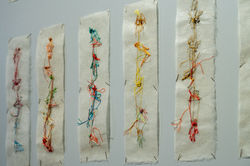
Cavallette (Grasshoppers) is a series of silkpaper strips with embroideries of grasshopper exuviae (spoils abandoned by the insect after the molt), that deals with food and famine, individual and collective change, interactions with the climate and the landscape. These questions and their potential answers live and alternate deep down inside oneself and inside every community. Grasshoppers in some cultures appear as symbol of fertility, good luck and immortality, while, in Western culture, locusts are usually associated to byblic peast, greed, tremendous avidity and calamity as some of the most devastant cataclysm. Protein resource in many countries, delicacy in other, food of the future with other insects, they become a terrible plague when, after a series of mutations, they constitute cluster so thick and crowded to resemble storm clouds covering the sky and the ground. Eating and sucking everything, they become cannybals and eat other grasshoppers of the same horde, reproducing themselves with incredibly speed and starving people and animals. These locust invasions are a really peast everywhere, but they are particularly terrible because of the climate change and in areas where people have not enough coordination, organization, instructions and means.
The installations presents the grasshoppers spoils as pictograms of a criptic language, a reference both to the Egiptian plagues, where they appear as destroyers, and the Chinese culture, where they have instead a good meaning and are associated to food, as in many other places in Asia.
Science Gallery Bengaluru (SGB) is a not-for-profit public institution for research-based engagement targeted at young adults working at the intersection of the human, natural, and social sciences, and engineering, art, and design.
SGB is established with the founding support of the Government of Karnataka and three academic partners—Indian Institute of Science, National Centre for Biological Sciences, and Srishti Institute of Art, Design and Technology. Science Gallery Bengaluru is part of the Science Gallery International Network pioneered by Trinity College Dublin.
Photos by Science Gallery Bengaluru
CALORIE | The Breakdown
Science Gallery Bengaluru con il supporto di Gates Foundation e British Council
9 Agosto2025 -31 Luglio 2026
Science Gallery Bengaluru
Bangalore, Karnataka, India
Cavallette
Ricami su silkpaper
Dimensioni site specific (circa 9x35 cm per 140 elementi su 144)
2012
La mostra CALORIE, della durata di un anno, esplora il rapporto dell'umanità con il cibo attraverso l'arte e la scienza.
Cavallette è una serie di strisce di silkpaper con ricamate exuvie di cavalletta (spoglie abbandonate dall'insetto dopo la muta), che affronta il tema del cibo e della carestia, del cambiamento individuale e collettivo, delle interazioni con il clima e il paesaggio. Queste domande e le loro potenziali risposte vivono e si alternano nel profondo di ognuno di noi e di ogni comunità. In alcune culture, le cavallette appaiono come simbolo di fertilità, buona sorte e immortalità, mentre in Occidente le locuste sono solitamente associate alle piaghe bibliche, alla voracità, all'avidità, come alcuni dei cataclismi più devastanti. Risorsa proteica in molti paesi, prelibatezza in altri, cibo del futuro con altri insetti, diventano una terribile calamità quando, dopo una serie di mutazioni, si formano sciami così densi e affollati da assomigliare a nubi temporalesche che coprono il cielo e la terra. Divorando e succhiando tutto, diventano sin cannibali, divorando altre cavallette della stessa orda, riproducendosi con incredibile velocità e affamando persone e animali. Le invasioni di locuste sono ovunque una vera piaga, ma risultano particolarmente terribili a causa del cambiamento climatico e in aree in cui le popolazioni non hanno sufficiente coordinamento, organizzazione, istruzione e mezzi.
L'installazione raffigura i resti di muta di cavalletta come pittogrammi di un linguaggio criptico: un riferimento sia alle Piaghe d'Egitto, dove questi ortotteri appaiono come entità distruttrici, sia alla cultura cinese, dove hanno invece un significato positivo e sono associati al cibo, come in molti altri luoghi dell'Asia.
La Science Gallery Bengaluru (SGB) è un'istituzione pubblica senza scopo di lucro che si occupa di ricerca e si rivolge a giovani adulti che lavorano all'intersezione tra scienze umane, naturali e sociali, ingegneria, arte e design.
La SGB è stata fondata con il supporto del Governo del Karnataka e di tre partner accademici: l'Indian Institute of Science, il National Centre for Biological Sciences e lo Srishti Institute of Art, Design and Technology. La Science Gallery Bengaluru fa parte del Science Gallery International Network, fondato dal Trinity College di Dublino.
Foto di Science Gallery Bengaluru